Voice to Text with Time Tracking for Freelancers
The freelance workforce keeps growing. According to Upwork’s research, over 64 million Americans freelanced in 2023, contributing $1.27 trillion to the economy. Yet the tools most freelancers use to track their time haven’t fundamentally changed in two decades: click start, click stop, fill in a description.
Here’s a workflow that millions of those freelancers repeat every day:
- Do the work
- Open a separate app to log the time
- Try to remember exactly what you did and when
- Get it approximately right
- Repeat until Friday, then bill
Steps 2 through 4 are where money disappears. Not in big dramatic ways. In small, consistent gaps that add up to thousands of dollars per year.
Two problems, one interaction
Freelancers have two persistent friction points: getting text into apps quickly and tracking billable hours accurately.
Most people solve these with two separate tools. A dictation app for faster text input. A time tracker like Toggl or Harvest for hours.
But what if the moment you spoke your work into existence, the time was already tracked?
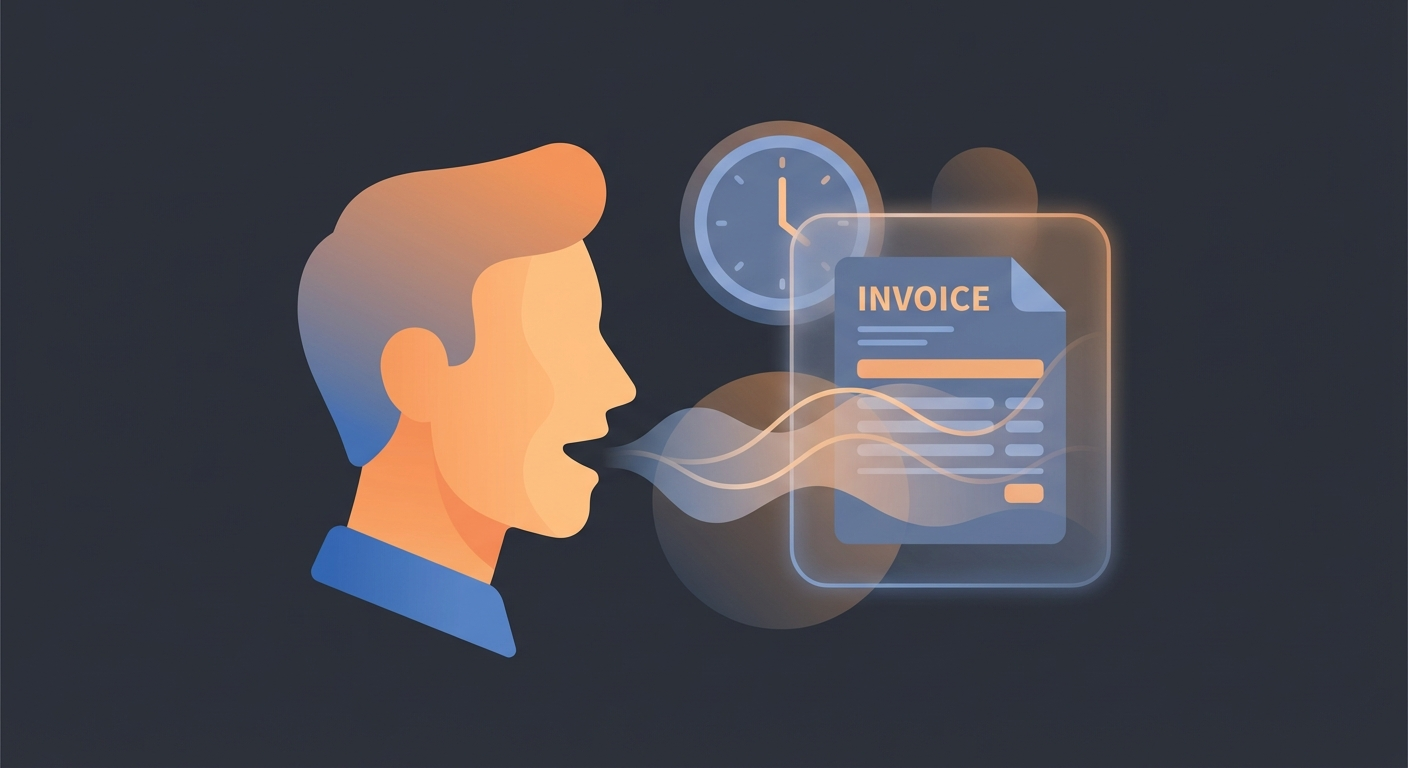
That’s the idea behind combining voice-to-text with automatic time tracking. You dictate what you worked on. The text goes where it needs to go. A time entry gets created simultaneously. One action, both problems solved.
How it works in practice
You’re a UX designer. You just finished a 90-minute session redesigning the checkout flow for a client.
Old way: Open Figma. Switch to Toggl. Create entry. Pick project. Type description. Enter duration. Switch back to work. (45 seconds, requires remembering to do it.)
New way: Press keyboard shortcut. Say “90 minutes on checkout flow redesign for Acme.” Keep working. (4 seconds, happens naturally.)
The time entry exists. The description is accurate because you said it in your own words. The hours get billed.
Multiply that by 20-30 entries per week and the time savings are significant. But the real win isn’t speed. It’s consistency. You actually do it every time because the effort is nearly zero.
The consistency problem
The number one reason freelancers underbill is not laziness or bad math. It’s inconsistency.
You track time diligently on Monday. By Wednesday, you’re forgetting to start timers. By Friday, you’re reconstructing the week from memory and Slack messages.
This isn’t a discipline problem. It’s a design problem. Any system that requires you to stop working, switch context, and manually enter data will eventually get skipped. The question is when, not if.
Voice capture solves this by making the tracking action smaller than the act of ignoring it. Speaking for 3 seconds is less effort than deciding not to track. So you just do it.
What to look for in a tool
If you’re evaluating voice-to-text tools as a freelancer, here’s what matters:
Speed. Latency under 200ms means the text appears as you speak. Anything over 500ms feels sluggish and breaks your flow.
System-wide input. It should work in every app, not just a dedicated text field. You dictate into Slack, emails, documents, code editors, whatever you’re working in.
Automatic time entries. The whole point is eliminating the separate tracking step. If you still have to manually create time entries, you’ve gained dictation but haven’t solved the billing problem.
Reports and export. Your time data needs to go somewhere useful. CSV export, client reports, integration with invoicing tools.
Keyboard shortcut trigger. No clicking menu bar icons. A global hotkey that works from any app.
The math
Conservative estimate: voice time tracking captures 4 extra hours per week that would otherwise go unlogged. At $75/hour, that’s $300/week or $15,600/year.
The tool costs $9/month. The ROI is not subtle.
Even if the real number is half that (2 extra hours/week), you’re still looking at $7,800/year in recovered revenue from a $108/year subscription.
Getting started
Superscribe combines voice-to-text dictation with automatic time tracking. macOS and Windows. Free 5-minute demo, no account required.
The setup takes about a minute. The keyboard shortcut (Option+Space on Mac) becomes muscle memory within a day.
If you freelance and you’re not tracking every hour, you’re not charging for every hour. Voice makes it easy enough to actually do.
Further reading
The Bureau of Labor Statistics American Time Use Survey has fascinating data on how Americans actually spend their working hours. Self-employed individuals average 6 hours 22 minutes of work per day, but the gap between hours worked and hours billed is where the real story lies.
Related reading
Try Superscribe free
Dictate into any app. Track your time automatically. No credit card required.
Get Started